Global Temperature in 2025, 2026, 2027 - James Hansen et. al
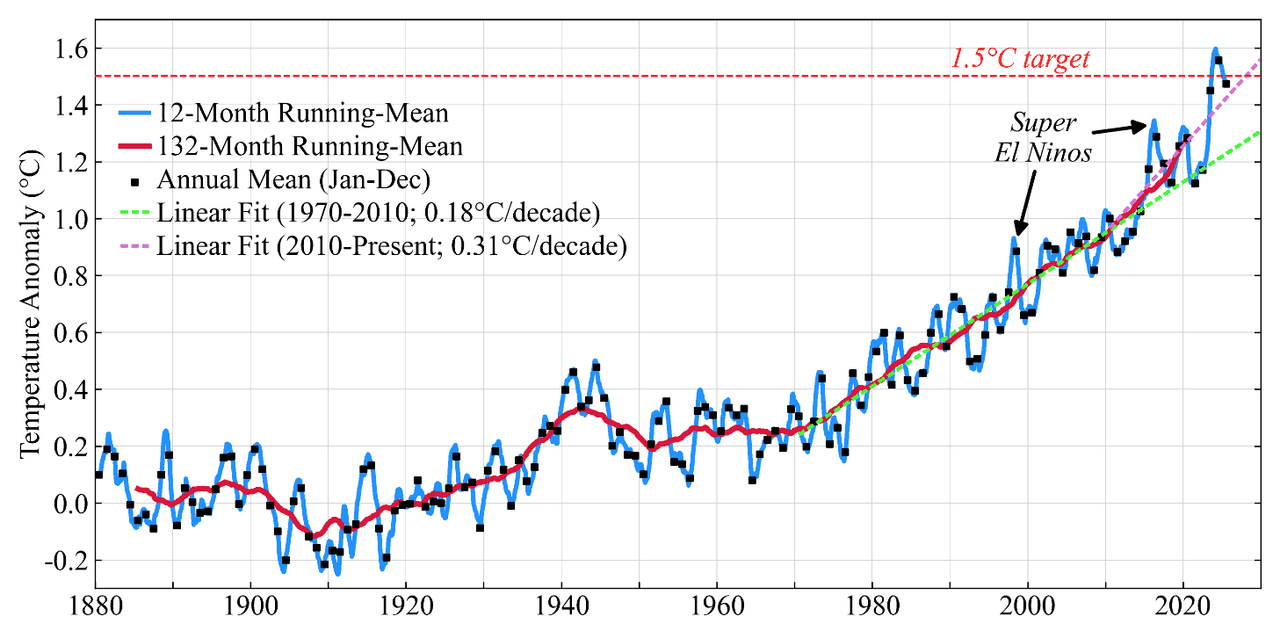
http://www.columbia.edu/~jeh1/mailings/2025/GlobalTemperaturePrediction2025.12.18.pdfFig. 1. Global surface temperature (relative to 1880-1920 base period).¹
 Global Temperature in 2025, 2026, 2027
18 December 2025
James Hansen, Pushker Kharecha, Dylan Morgan and Jasen Vest
Global Temperature in 2025, 2026, 2027
18 December 2025
James Hansen, Pushker Kharecha, Dylan Morgan and Jasen Vest
Abstract. Global temperature in 2025 declined 0.1°C from its El Nino-spurred maximum in 2024, making 2025 the second warmest year. The 2023-2025 mean is +1.5°C relative to 1880-1920. The 12-month running-mean temperature should decline for the next few months, reaching a minimum about +1.4°C. Later in 2026, we expect the 12-month running-mean temperature to begin to rise, as dynamical models show development of an El Nino. We project a global temperature record of +1.7°C in 2027, which will provide further confirmation of the recent global warming acceleration.
Global temperature of +1.47°C in 2025 relative to 1880-1920 is the 2 nd highest in the period of instrumental data, about 0.1°C cooler than the 2024 record high (Fig. 1) in the GISS (Goddard Institute for Space Studies) analysis. ¹ (We assume the remainder of this month will be about 0.1°C cooler than the same period in 2024; this uncertainty in the exact December temperature has imperceptible effect on the 2025 temperature in Fig. 1). The 3-year (2023-2025) temperature is +1.5°C relative to 1880-1920. We will provide details on the geographical and temporal temperature change in a communication in early 2026.
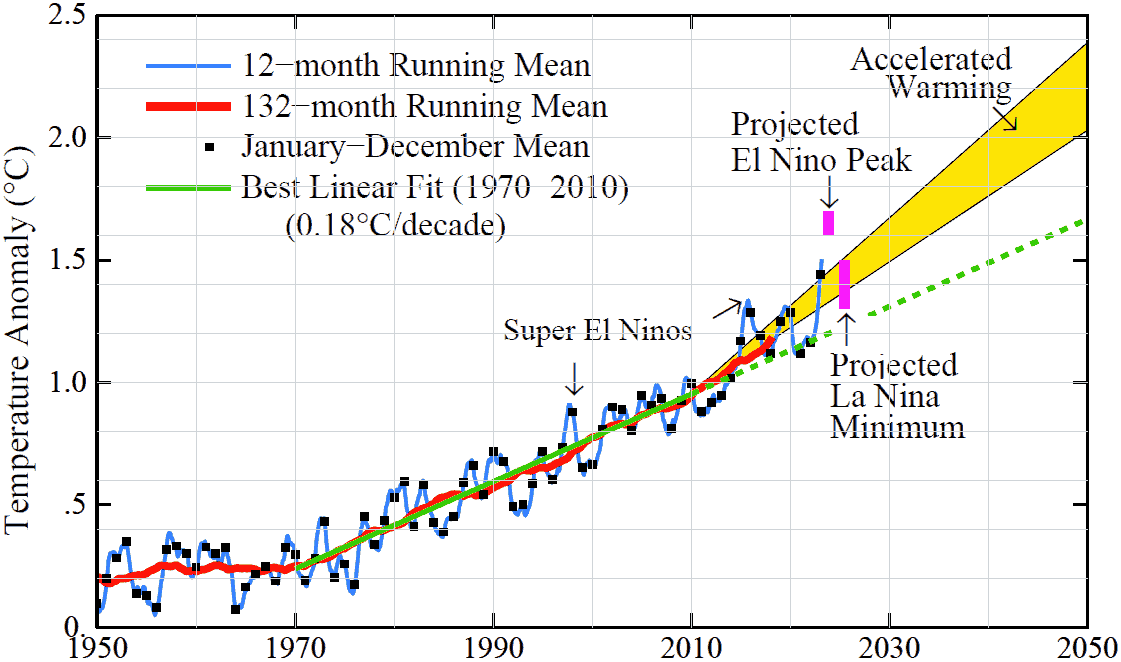
Two years ago (29 March 2024) we projected ² that global warming in the then-ongoing El Nino would rise much more than in prior El Ninos, raising global temperature to at least +1.6°C, and that temperature after the El Nino would fall only to +1.4°C (see Fig. 2). (Expectation of unusual warming was based on realization that a long-term global cooling effect of aerosols had recently shifted to warming, as we will discuss further in an upcoming post.) Consistent with this prior projection, we expect a minimum 12-month running-mean temperature of about +1.4°C to be reached in the first half of 2026, after which global temperature should begin a rise that will continue into 2027, reaching a new record high, as discussed below.
Fig. 2. Copy of Fig. 10 of “Global Warming Acceleration: Hope vs Hopium”²
 El Nino status.
 The tropical Pacific Ocean is presently in its cool La Nina phase, but there is evidence in numerous models that it will shift into the El Nino phase in 2026. Fig. 3 is the sea surface temperature (SST) anomaly (relative to the base period 1991-2020) in the Nino3.4 region in the tropical Pacific Ocean. This
Nino3.4 index characterizes the El Nino Southern Oscillation (ENSO) status, which is the largest natural source of global interannual temperature variability. Warm or cold anomalies need to exceed 0.5°C for several consecutive months to qualify as El Nino or La Nina. Beware that rapid global warming of the past half century is perturbing the quantitative significance of Nino3.4. ³ The strongest El Nino relative to its surroundings was the 1997-98 El Nino; the 2015-16 and 2023 El Nino strengths are exaggerated by the effect of global warming on the Nino3.4 index, which also diminishes apparent strength of recent La Ninas.
…
