
Researchers stunned by a forgotten medieval book in Rome hiding the oldest English poem
Source: AP
By ANDREA ROSA
Updated 8:18 AM CDT, May 17, 2026
ROME (AP) — The researchers in Ireland looked at their computer screen, marveling at a medieval book tracked down in a Roman library. They flipped through its digitized pages and found their sought-after treasure: the oldest surviving English poem.
“We were extremely surprised. We were speechless. We couldn’t believe our eyes when we first saw that,” Elisabetta Magnanti, a visiting research fellow at Trinity College Dublin’s school of English, told The Associated Press.
What’s more, she said, the poem was within the main body of Latin text: “It was extraordinary.”
Composed in Old English by a Northumbrian agricultural worker in the 7th century, “Caedmon’s Hymn” appears within some copies of the “Ecclesiastical History of the English People,” written in Latin by a monk and saint known as the Venerable Bede. His history is one of the most widely reproduced texts from the Middle Ages, with almost 200 manuscripts, according to Magnanti’s colleague Mark Faulkner, an associate professor of medieval literature at Trinity.
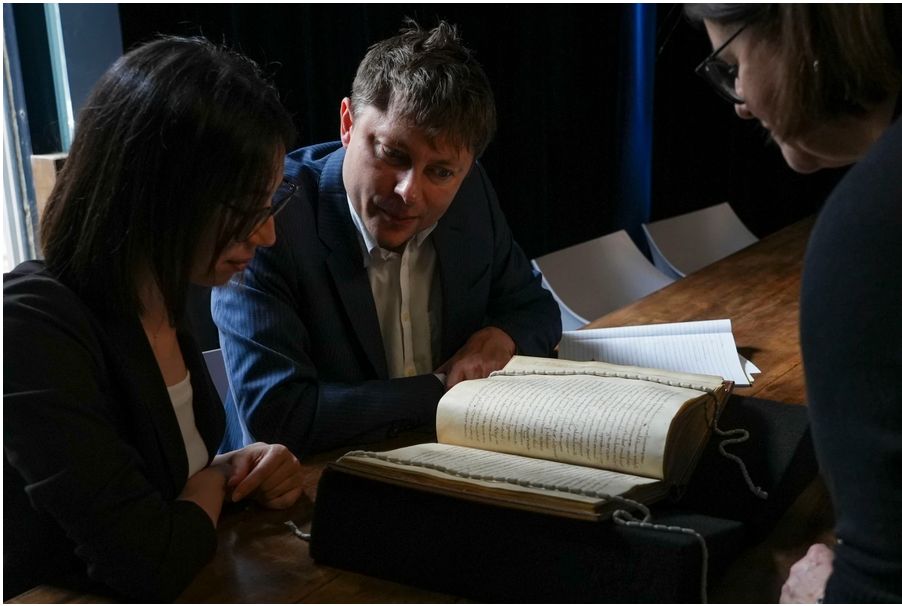
From left, Elisabetta Magnanti and Mark Faulkner from Dublin’s Trinity College and Valentina Longo of Rome’s National Central Library look at a manuscript containing a rare, long-lost copy of Caedmon’s Hymn, the first poem ever to be written down in Old English, at Rome’s National Library, Thursday, May 8, 2026. (AP Photo/Andrea Rosa)
Read more: https://apnews.com/article/old-english-manuscript-poetry-bede-caedmon-hymn-latin-italy-106769c014901cf06d8a56839d56ac90
 = new reply since forum marked as read
Highlight:
NoneDon't highlight anything
5 newestHighlight 5 most recent replies
= new reply since forum marked as read
Highlight:
NoneDon't highlight anything
5 newestHighlight 5 most recent replies

2na fisherman
(359 posts)So there is some chance that my word art may be discovered centuries from now. Perhaps some future scholars may uncover writings among those primitive eBooks. But they may have trouble accessing the digital text on a substitute for something once called a Kindle Reader.

ancianita
(43,344 posts)Nū scylun hergan hefaenrīcaes Uard,
metudæs maecti end his mōdgidanc,
uerc Uuldurfadur, suē hē uundra gihuaes,
ēci dryctin ōr āstelidæ
hē ǣrist scōp aelda barnum
heben til hrōfe, hāleg scepen.
Thā middungeard moncynnæs Uard,
eci Dryctin, æfter tīadæ
fīrum foldu, Frēa allmectig.[7]
Translation:
Now [we] shall honour / heaven-kingdom's guardian,
the measurer's might / and his mind's plan,
the work of the father of glory[a] / as he of each wonder,
eternal lord, / the origin established;
he first created[c] / for the children of men[d]
heaven for a roof, / holy creator.
Then Middle-earth / mankind's guardian,
eternal Lord, / after bestowed
the lands to men,[e] / Lord almighty.
Although the different Old English versions do not diverge from one another enormously, they vary enough that researchers have been able to reconstruct five substantively different variants of the poem, witnessed by different groups of the twenty-three manuscripts.[8]: §5.1
Guardian of heaven whom we come to praise
who mapped creation in His thought's sinews
Glory-Father who worked out each wonder
began with broad earth a gift for His children
first roofed it with heaven the Holy Shaper
established it forever as in the beginning
called it middle kingdom fenced it with angels
created a habitation for man to praise His splendor
Bede's story
Cædmon's Hymn survives only in manuscripts of Bede's Historia ecclesiastica gentis Anglorum, which recounts the poem as part of an elaborate miracle-story. Bede's chronology suggests that these events took place under the abbacy of Hilda of Whitby (658–80),[8]: §1 or in the decade after her death.[11] Whether Bede had this story directly from oral sources or whether he had access to a written account is a matter of debate,[12] but although world literature attests to many stories of poetic inspiration that recall Bede's, none is similar enough to be a likely source.[8]: §2 [13][14]
That the same copy is found in Rome’s National Central Library look at a manuscript containing a rare, long-lost copy of Caedmon’s Hymn, just doesn't seem like such a big deal, but the distribution of the Venerable Bede's writing definitely is.

Ponietz
(4,420 posts)
JoseBalow
(9,733 posts)